Learn narration (direct and indirect speech) with all the rules: reporting verb, conjunction, pronoun (SON) change, tense backshift, and time words, plus rules for assertive, interrogative, imperative, exclamatory, optative, Let, and Must sentences, with Bengali meanings and exercises.
There are two ways to report what a person said. You can quote their exact words, like “I am tired,” he said. Or you can report the idea in your own words, like he said that he was tired. The first is direct speech; the second is indirect speech. Changing one into the other is called narration, and it is one of the most tested topics in SSC, HSC, admission, and job exams.
It looks frightening at first, because so many things seem to change at once, the pronouns, the tense, the time words. But here is the truth: every single change follows a fixed rule. Learn the rules, and narration turns into a simple, step-by-step machine that you can run on any sentence. In this lesson: Narration: Direct and Indirect Speech Rules, I will teach you all of them.
একজন মানুষ কী বলেছে তা জানানোর দুটি উপায় আছে। তুমি তার বলা কথাগুলো হুবহু উদ্ধৃত করতে পারো, যেমন: “I am tired,” he said. আবার তুমি নিজের ভাষায় কথাটির মূল ভাবও জানাতে পারো, যেমন: he said that he was tired. প্রথমটিকে direct speech এবং দ্বিতীয়টিকে indirect speech বলা হয়। একটিকে অন্যটিতে পরিবর্তন করার প্রক্রিয়াকে narration বলা হয়, আর এটি SSC, HSC, ভর্তি এবং চাকরির পরীক্ষায় সবচেয়ে বেশি আসা বিষয়গুলোর একটি।
প্রথমে বিষয়টি কঠিন মনে হতে পারে, কারণ একসঙ্গে অনেক কিছু পরিবর্তিত হয় বলে মনে হয়: pronoun, tense এবং সময় বোঝানো শব্দ (Adverbials)। কিন্তু আসল কথা হলো, প্রতিটি পরিবর্তনের পেছনেই একটি নির্দিষ্ট নিয়ম আছে। নিয়মগুলো শিখে ফেললে narration একটি সহজ, ধাপে ধাপে অনুসরণযোগ্য প্রক্রিয়ায় পরিণত হয়, যা তুমি যেকোনো sentence-এর ক্ষেত্রে প্রয়োগ করতে পারবে।
এই পাঠে আমি তোমাকে Narration: Direct and Indirect Speech পরিবর্তনের সব গুরুত্বপূর্ণ নিয়ম শেখাব।
Direct Speech and Indirect Speech
Direct speech gives the exact words of the speaker, kept inside quotation marks, with a reporting verb (like ‘said’) before them. Indirect speech reports the same idea without quotation marks, changing the pronouns, tense, and time words to fit the reporter’s point of view. The two parts of the sentence are the reporting verb (He said) and the reported speech (the words spoken).
Direct speech-এ বক্তার বলা কথাগুলো হুবহু quotation mark-এর মধ্যে লেখা হয় এবং এর সঙ্গে ‘said’-এর মতো একটি reporting verb থাকে। Indirect speech-এ একই বক্তব্য quotation mark ছাড়া প্রকাশ করা হয় এবং বক্তার কথা যিনি জানাচ্ছেন, তার দৃষ্টিভঙ্গি অনুযায়ী pronoun, tense এবং সময় বোঝানো শব্দ পরিবর্তন করা হয়। এই ধরনের sentence-এর দুটি প্রধান অংশ থাকে: reporting verb, যেমন “He said”, এবং reported speech, অর্থাৎ বক্তা যে কথাগুলো বলেছিল।
- Direct: He said, “I am ill.”
- Indirect: He said that he was ill.
The Master Structure of Narration Change
Before the rules, let me hand you one simple picture that makes the whole topic click. Every narration sentence is made of just two parts: the reporting verb (R.V.), the bit that tells us who spoke, and the reported speech (R.S.), the actual words inside the quotation marks.
Narration পরিবর্তনের নিয়মগুলো শেখার আগে একটি সহজ ধারণা মনে রাখো, যা পুরো বিষয়টি বুঝতে অনেক সাহায্য করবে। প্রতিটি narration sentence মূলত মাত্র দুটি অংশ নিয়ে গঠিত। প্রথম অংশ হলো reporting verb (R.V.), যা বলে কে কথা বলেছে। দ্বিতীয় অংশ হলো reported speech (R.S.), অর্থাৎ quotation mark-এর ভেতরে থাকা বক্তার আসল কথাগুলো।
| He said to me, | “I have finished my work today.” |
|---|---|
| Reporting Verb (R.V.) | Reported Speech (R.S.) |
Now here is the beautiful part. In the reporting verb, you change only one thing: the verb (said, told, asked, ordered). In the reported speech, you change only three things, and you can remember them as P-T-A: the Person (pronouns), the Tense of the verb, and the Adverbials (the time and place words). Everything else in the sentence stays exactly as it is.
এবার আসি সহজ অংশে। নিচে দেওয়া সূত্রটি দেখো narration পরিবর্তনের গঠন সহজে মনে রাখার জন্য।
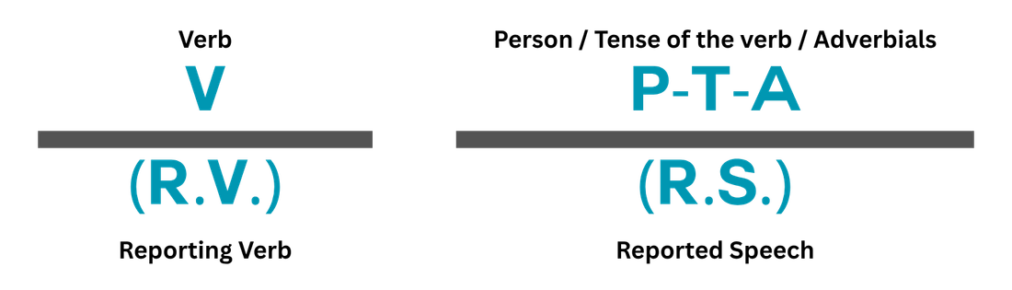
Reporting verb (R.V.)-এ তোমাকে শুধু একটি জিনিস পরিবর্তন করতে হয়: verb, যেমন said, told, asked, ordered।
আর reported speech (R.S.)-এ পরিবর্তন করতে হয় মাত্র তিনটি বিষয়। এগুলো P-T-A হিসেবে মনে রাখতে পারো:
P = Person, অর্থাৎ pronoun
T = Tense, অর্থাৎ verb-এর tense
A = Adverbials, অর্থাৎ সময় ও স্থান বোঝানো শব্দ
Sentence-এর বাকি সবকিছু সাধারণত অপরিবর্তিত থাকে।
- In the R.V.: change the Verb. (R.V. এ verb টা বদলাও।)
- In the R.S.: change the Person, the Tense, and the Adverbials. (R.S. এ Person, Tense, আর Adverbials বদলাও।)
There is a real magic hidden in this. Because you only ever touch these few elements, you can change a sentence correctly even when its full meaning is not clear to you. Just find the person, the tense, and the time words, change them by the rules below, and leave the rest alone. The five rules that follow are simply this master idea, spelled out step by step.
এর মধ্যে আসল সহজ কৌশলটি এখানেই। যেহেতু তোমাকে সব সময় মাত্র কয়েকটি নির্দিষ্ট অংশ পরিবর্তন করতে হয়, তাই sentence-এর পুরো অর্থ তোমার কাছে সম্পূর্ণ পরিষ্কার না হলেও তুমি সেটিকে সঠিকভাবে পরিবর্তন করতে পারবে।
শুধু Person, Tense এবং সময় বা স্থান বোঝানো word খুঁজে বের করো, নিচের নিয়ম অনুযায়ী সেগুলো পরিবর্তন করো এবং sentence-এর বাকি অংশ অপরিবর্তিত রাখো।
এরপরের পাঁচটি নিয়ম আসলে এই একটি মূল ধারণাকেই ধাপে ধাপে বিস্তারিতভাবে ব্যাখ্যা করে।
The 5 Universal Rules of Narration
Every narration change, no matter the sentence type, runs on these five rules. Learn them first.
প্রতিটা narration পরিবর্তন, বাক্যের ধরন যাই হোক, এই পাঁচটা নিয়মে চলে। আগে এগুলো শেখো।
Rule 1: Remove the Quotation Marks
The very first thing you do is take away the inverted commas and the comma before them. In indirect speech we no longer quote the exact words, so those marks have no place. Everything else follows from this one step.
প্রথম কাজ হলো inverted comma এবং তার আগে থাকা comma তুলে দেওয়া। Indirect speech-এ বক্তার কথা আর হুবহু উদ্ধৃত করা হয় না, তাই এই punctuation mark-গুলোর আর প্রয়োজন থাকে না। এই প্রথম ধাপটি সম্পন্ন করার পরই বাকি পরিবর্তনগুলো একে একে করা হয়।
Rule 2: Change the Reporting Verb to Match the Type
The reporting verb changes to fit the kind of sentence. For a statement, ‘said to’ becomes ‘told’. For a question, it becomes ‘asked’. For a command or request, it becomes ‘ordered’ or ‘requested’. So your very first job is always to spot the sentence type.
Reporting verb sentence-এর ধরন অনুযায়ী পরিবর্তিত হয়। Statement হলে ‘said to’ পরিবর্তন হয়ে ‘told’ হয়। Question হলে এটি ‘asked’ হয়। আর command বা request হলে ‘ordered’ বা ‘requested’ ব্যবহার করা হয়। তাই তোমার প্রথম কাজ হলো sentence-এর ধরন চিহ্নিত করা। এটি দ্রুত বুঝতে আমাদের Kinds of Sentences বিষয়ক পাঠটি পড়তে পারো।
Rule 3: Add the Right Conjunction
After the reporting verb, add the linking word that matches the type: ‘that’ for a statement, ‘if’ or ‘whether’ for a yes-or-no question, the wh-word itself for a wh-question, and ‘to’ for a command or request.
Reporting verb-এর পরে sentence-এর ধরন অনুযায়ী উপযুক্ত linking word যোগ করতে হবে। Statement হলে ‘that’, yes-or-no question হলে ‘if’ বা ‘whether’, wh-question হলে সেই wh-word-টিই, আর command বা request হলে ‘to’ ব্যবহার করতে হবে।
Rule 4: Change the Pronouns (the SON Rule)
Pronouns change by a simple rule I call SON. The Subject-side pronoun (the first person: I, we, my) changes like the subject of the reporting verb. The Object-side pronoun (the second person: you, your) changes like the object of the reporting verb. And the third person (he, she, they, it) has No change. Subject, Object, No change, that is SON.
Pronoun পরিবর্তনের জন্য একটি সহজ নিয়ম মনে রাখতে পারো, যাকে SON বলা হয়।
- S = Subject: first person pronoun, যেমন I, we, my, reporting verb-এর subject অনুযায়ী পরিবর্তিত হয়।
- O = Object: second person pronoun, যেমন you, your, reporting verb-এর object অনুযায়ী পরিবর্তিত হয়।
- N = No change: third person pronoun, যেমন he, she, they, it, সাধারণত পরিবর্তিত হয় না।
অর্থাৎ, Subject, Object, No change—এই তিনটি শব্দের প্রথম অক্ষর মিলিয়েই SON।
Pronoun-এর নিয়ম আরও ভালোভাবে বুঝতে আমাদের Pronoun বিষয়ক পাঠটি পড়তে পারো।
Rule 5: Change the Tense (Backshift), If the Reporting Verb is Past
This is the big one. If the reporting verb is in the past tense (said, told, asked), the verb inside moves one step back: present becomes past, past becomes past perfect, ‘will’ becomes ‘would’. But if the reporting verb is in the present or future (says, will say), the tense does not change at all. And a universal truth, like the sun rising in the east, always stays in the present.
এটি সবচেয়ে গুরুত্বপূর্ণ নিয়মগুলোর একটি। Reporting verb যদি past tense-এ থাকে, যেমন said, told, asked, তাহলে reported speech-এর verb এক ধাপ পিছিয়ে যায়: present tense পরিবর্তিত হয়ে past tense হয়, past tense পরিবর্তিত হয়ে past perfect হয়, আর ‘will’ পরিবর্তিত হয়ে ‘would’ হয়।
কিন্তু reporting verb যদি present বা future tense-এ থাকে, যেমন says বা will say, তাহলে reported speech-এর tense পরিবর্তিত হয় না। আর universal truth, যেমন সূর্য পূর্ব দিকে উদিত হয়, সব সময় present tense-এই থাকে। এ বিষয়ে আরও ভালোভাবে জানতে আমাদের Tenses এবং Modal Verbs বিষয়ক পাঠগুলো পড়তে পারো।
The Tense Change Chart (Backshift)
Use this when the reporting verb is in the past tense.
reporting verb past tense এ থাকলে এটা ব্যবহার করো।
| Direct (Tense) | Indirect (Tense) | Example |
|---|---|---|
| Present simple (play) | Past simple (played) | “I play” → he played |
| Present continuous (am playing) | Past continuous (was playing) | “I am playing” → he was playing |
| Present perfect (have played) | Past perfect (had played) | “I have played” → he had played |
| Past simple (played) | Past perfect (had played) | “I played” → he had played |
| will / shall | would / should | “I will go” → he would go |
| can / may / must | could / might / must | “I can go” → he could go |
The Pronoun Chart (SON Rule)
| Pronoun in Direct | Changes according to |
|---|---|
| First person: I, we, my, our (প্রথম পুরুষ) | the subject of the reporting verb (subject অনুযায়ী) |
| Second person: you, your (দ্বিতীয় পুরুষ) | the object of the reporting verb (object অনুযায়ী) |
| Third person: he, she, they, it (তৃতীয় পুরুষ) | no change (কোনো পরিবর্তন নেই) |
The Time and Place Words Chart
Words that point to ‘near’ change to point to ‘far’.
‘কাছে’ বোঝানো শব্দ বদলে ‘দূরে’ বোঝায়।
| Direct (near) | Indirect (far) |
|---|---|
| now (এখন) | then (তখন) |
| today (আজ) | that day (সেদিন) |
| tomorrow (আগামীকাল) | the next day (পরদিন) |
| yesterday (গতকাল) | the previous day (আগের দিন) |
| tonight (আজ রাতে) | that night (সেই রাতে) |
| ago (আগে) | before (পূর্বে) |
| here (এখানে) | there (সেখানে) |
| this (এই) | that (ওই) |
| these (এইগুলো) | those (ওইগুলো) |
| come (আসা) | go (যাওয়া) |
Direct and Indirect Speech Rules by Sentence Type
Now the type-by-type rules, with examples for each.
এবার ধরন অনুযায়ী নিয়ম, প্রতিটার উদাহরণসহ।
Here is a summary chart of all the structures first. Keep it for quick revision; each row is explained in detail below.
আগে সব structure এর একটা সারসংক্ষেপ চার্ট দেওয়া হলো। দ্রুত রিভিশনের জন্য রেখে দাও; প্রতিটা সারি নিচে বিস্তারিত ব্যাখ্যা করা আছে।
| Sentence category | Reporting verb | Connecting word | Reported speech structure |
|---|---|---|---|
| Assertive (বিবৃতি) | say / said to, tell / told | that | subject + verb + object + extra |
| Interrogative (প্রশ্ন) | ask / asked, enquire of | if / whether (yes-no); same wh-word (wh-question) | subject + verb + object + extra |
| Imperative (আদেশ / অনুরোধ) | order / ordered, request / requested, advise / advised, forbid / forbade | to (positive); not to (negative) | verb + extra |
| Optative (ইচ্ছা / প্রার্থনা) | pray / prayed, wish / wished | that | subject + might + verb + object + extra |
| Exclamatory (বিস্ময়) | exclaim / exclaimed with joy / sorrow / wonder | that | subject + verb + very / a great + adjective + extra |
| Let us (প্রস্তাব) | propose / proposed, suggest / suggested | that | subject + should + verb + extra |
| Let me / him / them (অনুমতি) | wish / wished, tell / told | that | subject + might + verb + extra |
| Must (বাধ্যবাধকতা) | tell / told | that | subject + must / had to / would have to + verb + object + extra |
Type 1: Assertive Sentences (Statements)
For a simple statement, keep ‘said’ as ‘said’, but change ‘said to’ into ‘told’. Add the conjunction ‘that’, then change the pronoun and tense by the rules above. This is the easiest and most common type.
সাধারণ বিবৃতি (Simple statement)-এর ক্ষেত্রে ‘said’ অপরিবর্তিত থাকে, কিন্তু ‘said to’ পরিবর্তিত হয়ে ‘told’ হয়। এরপর conjunction ‘that’ যোগ করো এবং উপরের নিয়ম অনুযায়ী pronoun ও tense পরিবর্তন করো। এটি Narration-এর সবচেয়ে সহজ এবং সবচেয়ে বেশি ব্যবহৃত ধরন।
একটা সাধারণ বিবৃতিতে ‘said’ কে ‘said’ রাখো, কিন্তু ‘said to’ কে ‘told’ করো। জোড়া-শব্দ ‘that’ বসাও, তারপর উপরের নিয়মে pronoun আর tense বদলাও। এটাই সবচেয়ে সহজ ও সাধারণ ধরন।
Examples:
- Direct: He said to me, “I am busy.”
- Indirect: He told me that he was busy.
- Direct: She said, “I have done my work.”
- Indirect: She said that she had done her work.
Type 2: Interrogative Sentences (Questions)
For a question, change ‘said to’ into ‘asked’ (or ‘enquired of’). Turn the question into a statement, that is, put the subject before the verb, and remove the question mark. For a yes-or-no question, add ‘if’ or ‘whether’; for a wh-question, keep the wh-word and add no other conjunction. Drop ‘do’, ‘does’, or ‘did’.
Question-এর ক্ষেত্রে ‘said to’ পরিবর্তন করে ‘asked’ বা ‘enquired of’ ব্যবহার করো। তারপর interrogative sentence-টিকে statement-এর গঠনে নিয়ে আসো, অর্থাৎ subject-কে verb-এর আগে বসাও এবং question mark বাদ দাও।
Yes-or-no question হলে ‘if’ বা ‘whether’ যোগ করো। আর wh-question হলে সেই wh-word-টিই রেখে দাও; অন্য কোনো conjunction যোগ করার দরকার নেই। ‘do’, ‘does’ বা ‘did’ থাকলে সেগুলোও বাদ দিতে হবে।
এই নিয়মটি আরও ভালোভাবে বুঝতে আমাদের Assertive to Interrogative বিষয়ক পাঠটি পড়তে পারো।
Examples:
- Direct: He said to me, “Are you happy?”
- Indirect: He asked me if I was happy.
- Direct: She said to him, “Where do you live?”
- Indirect: She asked him where he lived.
Type 3: Imperative Sentences (Commands, Requests, Advice)
For a command, request, or piece of advice, change the reporting verb to ‘ordered’, ‘requested’, ‘advised’, or ‘forbade’, to match the tone. Then use ‘to’ plus the verb, or ‘not to’ for a negative. There is no tense change here, because the verb becomes an infinitive. A ‘Let us’ sentence becomes ‘proposed that … should’.
Command, request বা advice-এর ক্ষেত্রে কথার ভঙ্গি অনুযায়ী reporting verb পরিবর্তন করে ‘ordered’, ‘requested’, ‘advised’ বা ‘forbade’ ব্যবহার করো। এরপর ‘to + verb’ ব্যবহার করো। Negative হলে ‘not to + verb’ ব্যবহার করবে। এখানে tense পরিবর্তন হয় না, কারণ verb infinitive-এ পরিণত হয়। ‘Let us’ দিয়ে শুরু হওয়া sentence সাধারণত ‘proposed that … should’ গঠনে পরিবর্তিত হয়।
এ বিষয়ে আরও ভালোভাবে বুঝতে আমাদের Assertive to Imperative বিষয়ক পাঠটি পড়তে পারো।
Examples:
- Direct: He said to me, “Go away.”
- Indirect: He ordered me to go away.
- Direct: She said to him, “Please help me.”
- Indirect: She requested him to help her.
- Direct: The teacher said, “Do not make noise.”
- Indirect: The teacher told the students not to make noise.
Type 4: Exclamatory Sentences (Joy, Sorrow, Wonder)
For an exclamatory sentence, change the reporting verb to ‘exclaimed’, and add the feeling: ‘with joy’, ‘with sorrow’, or ‘with wonder’. Remove the interjection (Alas, Hurrah, Bravo) and the exclamation mark, add ‘that’, and turn ‘What a’ or ‘How’ into ‘very’ or ‘great’.
Exclamatory sentence-এর ক্ষেত্রে reporting verb পরিবর্তন করে ‘exclaimed’ ব্যবহার করো এবং অনুভূতি অনুযায়ী ‘with joy’, ‘with sorrow’ বা ‘with wonder’ যোগ করো। Alas, Hurrah, Bravo-এর মতো interjection এবং exclamation mark বাদ দাও, তারপর ‘that’ যোগ করো। ‘What a’ বা ‘How’ থাকলে সেগুলোকে অর্থ অনুযায়ী ‘very’ বা ‘great’-এ পরিবর্তন করো।
এর বিপরীত রূপান্তরের নিয়ম জানতে আমাদের Assertive to Exclamatory বিষয়ক পাঠটি পড়তে পারো।
Examples:
- Direct: He said, “Alas! I am ruined.”
- Indirect: He exclaimed with sorrow that he was ruined.
- Direct: She said, “Hurrah! We have won the match.”
- Indirect: She exclaimed with joy that they had won the match.
Type 5: Optative Sentences (Wishes and Prayers)
For a wish or a prayer, change the reporting verb to ‘wished’ or ‘prayed’, add ‘that’, and often use ‘might’. Remove the exclamation mark.
Wish বা prayer বোঝানো sentence-এর ক্ষেত্রে reporting verb পরিবর্তন করে ‘wished’ বা ‘prayed’ ব্যবহার করো। এরপর ‘that’ যোগ করো এবং প্রয়োজন অনুযায়ী প্রায়ই ‘might’ ব্যবহার করা হয়। সবশেষে exclamation mark বাদ দাও।
Examples:
- Direct: The old man said, “May you live long!”
- Indirect: The old man prayed that I might live long.
- Direct: She said, “May God bless you!”
- Indirect: She prayed that God might bless me.
Type 6: Sentences with ‘Let’ (Proposal or Permission)
A sentence beginning with ‘let’ needs special care, because ‘let us’ and ‘let me’ do different jobs. ‘Let us’ makes a proposal or suggestion, so the reporting verb becomes ‘proposed’ or ‘suggested’, and the reported part becomes ‘that we should …’. ‘Let me’, ‘let him’, or ‘let them’ asks for permission, so the reporting verb becomes ‘wished’ or ‘told’, and the reported part uses ‘might’.
‘let’ দিয়ে শুরু হওয়া sentence-এর ক্ষেত্রে বিশেষভাবে সতর্ক থাকতে হবে, কারণ ‘let us’ এবং ‘let me’ ভিন্ন কাজ করে। ‘Let us’ কোনো প্রস্তাব বা পরামর্শ বোঝায়। তাই reporting verb পরিবর্তন করে ‘proposed’ বা ‘suggested’ ব্যবহার করা হয়, আর reported speech সাধারণত ‘that we should …’ গঠনে লেখা হয়।
অন্যদিকে, ‘Let me’, ‘let him’ বা ‘let them’ অনুমতি চাওয়া বোঝায়। এ ক্ষেত্রে reporting verb অর্থ অনুযায়ী ‘wished’ বা ‘told’ হয় এবং reported speech-এ সাধারণত ‘might’ ব্যবহার করা হয়।
Examples:
- Direct: He said to me, “Let us play cricket now.” (proposal)
- Indirect: He proposed to me that we should play cricket then.
- Direct: He said, “Let him stay here.” (permission)
- Indirect: He wished that he might stay there.
Type 7: Sentences with ‘Must’
When the reported speech contains ‘must’, the reporting verb becomes ‘told’, and ‘must’ is treated by its meaning. If it shows a present obligation, ‘must’ stays ‘must’. If it shows a general or past necessity, ‘must’ becomes ‘had to’. If it shows a future obligation, ‘must’ becomes ‘would have to’.
Reported speech-এ ‘must’ থাকলে reporting verb সাধারণত ‘told’ হয়, আর ‘must’-এর পরিবর্তন তার অর্থের ওপর নির্ভর করে। যদি এটি present obligation বোঝায়, তাহলে ‘must’ অপরিবর্তিত থাকে। যদি এটি সাধারণ বা অতীতের necessity বোঝায়, তাহলে ‘must’ পরিবর্তিত হয়ে ‘had to’ হয়। আর যদি এটি future obligation বোঝায়, তাহলে ‘must’ পরিবর্তিত হয়ে ‘would have to’ হয়।
এই সূক্ষ্ম পার্থক্যগুলো আরও ভালোভাবে বুঝতে আমাদের Modal Verbs বিষয়ক পাঠটি পড়তে পারো।
Examples:
- Direct: He said to me, “You must obey your parents.” (present obligation)
- Indirect: He told me that I must obey my parents.
- Direct: He said to me, “You must water the garden.” (general necessity)
- Indirect: He told me that I had to water the garden.
Common Mistakes to Avoid
- Do not start changing the sentence before you have named its type. The rules for a statement and a question are completely different, so first ask: is this assertive, interrogative, imperative, exclamatory, or optative? That one habit prevents most errors.
- Do not backshift the tense of a universal truth. If the reported words state a fact that is always true, like “The sun rises in the east”, the tense stays in the present, even after ‘said’.
- Do not forget to change the time and place words. Many students change the tense but leave ‘now’, ‘today’, or ‘here’ unchanged. Remember: ‘now’ becomes ‘then’, ‘today’ becomes ‘that day’, and ‘here’ becomes ‘there’.
- Do not leave a question in question order. In indirect speech, a question becomes a statement, so the subject comes before the verb and the question mark is removed. Write “he asked where I lived”, not “he asked where did I live”.
যেসব সাধারণ ভুল এড়িয়ে চলবে
- sentence-এর ধরন চিহ্নিত করার আগে পরিবর্তন শুরু কোরো না। Statement এবং question-এর নিয়ম একেবারেই আলাদা। তাই প্রথমে নির্ধারণ করো: এটি assertive, interrogative, imperative, exclamatory নাকি optative sentence? এই একটি অভ্যাসই বেশিরভাগ ভুল এড়াতে সাহায্য করবে।
- universal truth-এর tense পরিবর্তন কোরো না। Reported speech-এ যদি এমন কোনো সত্য বলা হয় যা সব সময়ই সত্য, যেমন “The sun rises in the east”, তাহলে reporting verb ‘said’ হলেও tense present-এই থাকবে।
- সময় ও স্থান বোঝানো শব্দ পরিবর্তন করতে ভুলে যেয়ো না। অনেক শিক্ষার্থী tense পরিবর্তন করে, কিন্তু ‘now’, ‘today’ বা ‘here’ অপরিবর্তিত রেখে দেয়। মনে রাখো: ‘now’ পরিবর্তিত হয়ে ‘then’, ‘today’ পরিবর্তিত হয়ে ‘that day’, এবং ‘here’ পরিবর্তিত হয়ে ‘there’ হয়।
- question-কে question-এর word order-এ রেখে দিও না। Indirect speech-এ question statement-এর গঠনে চলে যায়, তাই subject verb-এর আগে বসে এবং question mark বাদ যায়। সঠিক হবে “he asked where I lived”, “he asked where did I live” নয়।
Practice Exercise with Answers
Change each sentence from direct into indirect speech.
প্রতিটা বাক্যকে direct থেকে indirect speech এ বদলাও। নিজে চেষ্টা করার পরে উত্তর মিলিয়ে নাও।
Part A (Assertive):
- He said, “I am busy now.”
- She said to me, “I will help you tomorrow.”
- Rahim said, “I have finished my work.”
- The teacher said, “The earth moves round the sun.”
- They said to us, “We went to school yesterday.”
Part B (Interrogative): 6. He said to me, “Are you happy?” 7. She said to him, “Where do you live?” 8. The stranger said to me, “What is your name?” 9. Mother said to me, “Have you taken your meal?”
Part C (Imperative): 10. He said to me, “Go away.” 11. She said to him, “Please help me.” 12. The teacher said to the boys, “Do not make noise.” 13. He said, “Let us play now.”
Part D (Exclamatory and Optative): 14. He said, “Alas! I am ruined.” 15. She said, “Hurrah! We have won the match.” 16. The old man said to me, “May you live long!” 17. He said, “What a beautiful scene it is!”
Part E (Let and Must): 18. He said to me, “Let us go for a walk now.” 19. He said, “Let him come in.” 20. He said to me, “You must obey the rules.”
Answers
Part A:
- He said that he was busy then.
- She told me that she would help me the next day.
- Rahim said that he had finished his work.
- The teacher said that the earth moves round the sun. (universal truth, no backshift)
- They told us that they had gone to school the previous day.
Part B: 6. He asked me if I was happy. 7. She asked him where he lived. 8. The stranger asked me what my name was. 9. Mother asked me if I had taken my meal.
Part C: 10. He ordered me to go away. 11. She requested him to help her. 12. The teacher ordered the boys not to make noise. 13. He proposed that they should play then.
Part D: 14. He exclaimed with sorrow that he was ruined. 15. She exclaimed with joy that they had won the match. 16. The old man prayed that I might live long. 17. He exclaimed with wonder that it was a very beautiful scene.
Part E: 18. He proposed to me that we should go for a walk then. 19. He wished that he might come in. 20. He told me that I must obey the rules.
A Tip for the Exam
The secret to narration is to work in a fixed order every time. First, name the sentence type, because that decides the reporting verb and the conjunction. Second, change the reporting verb and add the linking word. Third, fix the pronouns with the SON rule. Fourth, backshift the tense if the reporting verb is past, but never touch a universal truth. Fifth, change the time and place words.
Run these five steps in the same order on every sentence, practise a few daily, and this big-looking topic will become one of your most reliable sources of marks.
Narration-এর আসল কৌশল হলো প্রতিবার একটি নির্দিষ্ট ক্রম অনুসরণ করা।
প্রথমে sentence-এর ধরন চিহ্নিত করো, কারণ এর ওপরই reporting verb এবং conjunction নির্ভর করে। দ্বিতীয় ধাপে reporting verb পরিবর্তন করো এবং উপযুক্ত linking word যোগ করো। তৃতীয় ধাপে SON rule অনুযায়ী pronoun পরিবর্তন করো। চতুর্থ ধাপে reporting verb past tense-এ থাকলে tense backshift করো, তবে universal truth-এর tense কখনো পরিবর্তন করবে না। পঞ্চম ধাপে সময় ও স্থান বোঝানো শব্দগুলো পরিবর্তন করো।
প্রতিটি sentence-এর ক্ষেত্রে এই পাঁচটি ধাপ একই ক্রমে অনুসরণ করো এবং প্রতিদিন কয়েকটি sentence অনুশীলন করো। তাহলে প্রথমে বড় ও কঠিন মনে হওয়া এই বিষয়টিই ধীরে ধীরে পরীক্ষায় তোমার নির্ভরযোগ্য নম্বর পাওয়ার একটি অংশ হয়ে উঠবে।
Related Lessons
Keep building your grammar with these lessons:
- Transformation of Sentences: All Rules in One Guide
- Affirmative to Negative Transformation: Rules, Chart & Examples.
- Changing Degree: Positive, Comparative & Superlative Rules with Examples.
- Voice Change Rules: Active to Passive Voice with Examples
- Simple to Complex Sentence Transformation
- Complex to Compound Sentence Transformation
- Simple to Compound Sentence Transformation
- 12 Tenses in English Grammar: Full Classification
- Modal Verbs in English Grammar
- University & Medical Admission English Syllabus & Suggestion Guide
Frequently Asked Questions
What is narration in English grammar?
Narration is the process of changing direct speech (a speaker’s exact words in quotation marks) into indirect speech (a report of those words without quoting them), by adjusting the reporting verb, conjunction, pronouns, tense, and time words while keeping the meaning.
What are the main rules of direct and indirect speech?
The five main rules are: remove the quotation marks, change the reporting verb to match the sentence type, add the right conjunction (that, if/whether, a wh-word, or to), change the pronouns by the SON rule, and backshift the tense one step if the reporting verb is in the past.
When does the tense not change in indirect speech?
The tense does not change when the reporting verb is in the present or future tense, or when the reported words state a universal truth, such as “The sun rises in the east”.
How do I change a question into indirect speech?
Change the reporting verb to ‘asked’, turn the question into a statement (subject before verb) and remove the question mark, add ‘if’ or ‘whether’ for a yes-or-no question, or keep the wh-word for a wh-question.
How do I change a command into indirect speech?
Change the reporting verb to ‘ordered’, ‘requested’, or ‘advised’ to match the tone, then use ‘to’ plus the verb, or ‘not to’ for a negative command. The verb becomes an infinitive, so the tense does not change.
How do I change ‘Let us’ and ‘Let me’ sentences?
‘Let us’ makes a proposal, so it becomes ‘proposed that we should …’. ‘Let me’, ‘let him’, or ‘let them’ asks for permission, so it becomes ‘wished that … might …’. For example, “Let us play” becomes “He proposed that they should play”, and “Let him come in” becomes “He wished that he might come in”.